

Why are your Meta Ads generating record-breaking click-through rates while your bottom line remains stagnant? It's a common frustration for Australian brands; you've invested heavily in premium creative, yet your landing page conversion optimization efforts haven't stopped your Cost Per Lead from climbing. You likely feel that your digital presence doesn't quite reflect your actual brand quality, leaving you stuck with low conversion rates and confusing technical jargon. We understand that seeing a high volume of traffic fail to take action is more than just a metric issue; it's a growth bottleneck.
This article will show you how to master the "Post-Click Scent" to transform your pages into high-performance sales machines. We'll move past the hype to deliver a pragmatic strategy for 2026 that turns expensive Meta Ads traffic into measurable business growth. You'll learn a repeatable framework for scaling your ad spend profitably, ensuring every A$1 spent on media works harder for your bottom line. We'll also examine the exact technical shifts required to outperform the 4.02% industry median, from mobile-first design to the critical impact of page load speeds on Australian networks.
Key Takeaways
- Understand why standard CRO isn't enough and how specialised landing page conversion optimisation for paid traffic secures your return on ad spend.
- Learn to capture attention in under three seconds by aligning your value proposition with the visual hierarchy that Australian consumers expect.
- Master the "Post-Click Scent" to eliminate the disconnect between your Meta Ads and your landing page, helping to reduce your Cost Per Lead.
- Transition from simple responsive design to a mobile-first architecture that caters to the 65% of Australian traffic arriving via handheld devices.
- Discover a repeatable framework for scaling your digital growth by treating your landing page as a core component of your broader sales funnel.
What is Landing Page Conversion Optimisation in a Paid Media Context?
Landing page conversion optimisation is the strategic process of enhancing every element on a standalone webpage to increase the percentage of visitors who complete a specific goal. While it shares foundations with the broader field of conversion rate optimization, LPO for paid media is a far more surgical discipline. It isn't about improving the general health of a website. It's about creating a high-performance environment designed specifically to receive and convert traffic from targeted sources like Meta Ads.
Most standard website pages fail as ad destinations because they weren't built for a "cold" audience arriving with a specific intent. A homepage is a digital foyer; it's designed for exploration. In contrast, an effective landing page is a closed loop. We focus on building "Conversion Momentum," ensuring the psychological drive that started with an ad click is maintained until the final form is submitted. If there is any friction or secondary distraction, that momentum dies, and your ad spend is wasted.
The Difference Between a Website and a High-Converting Landing Page
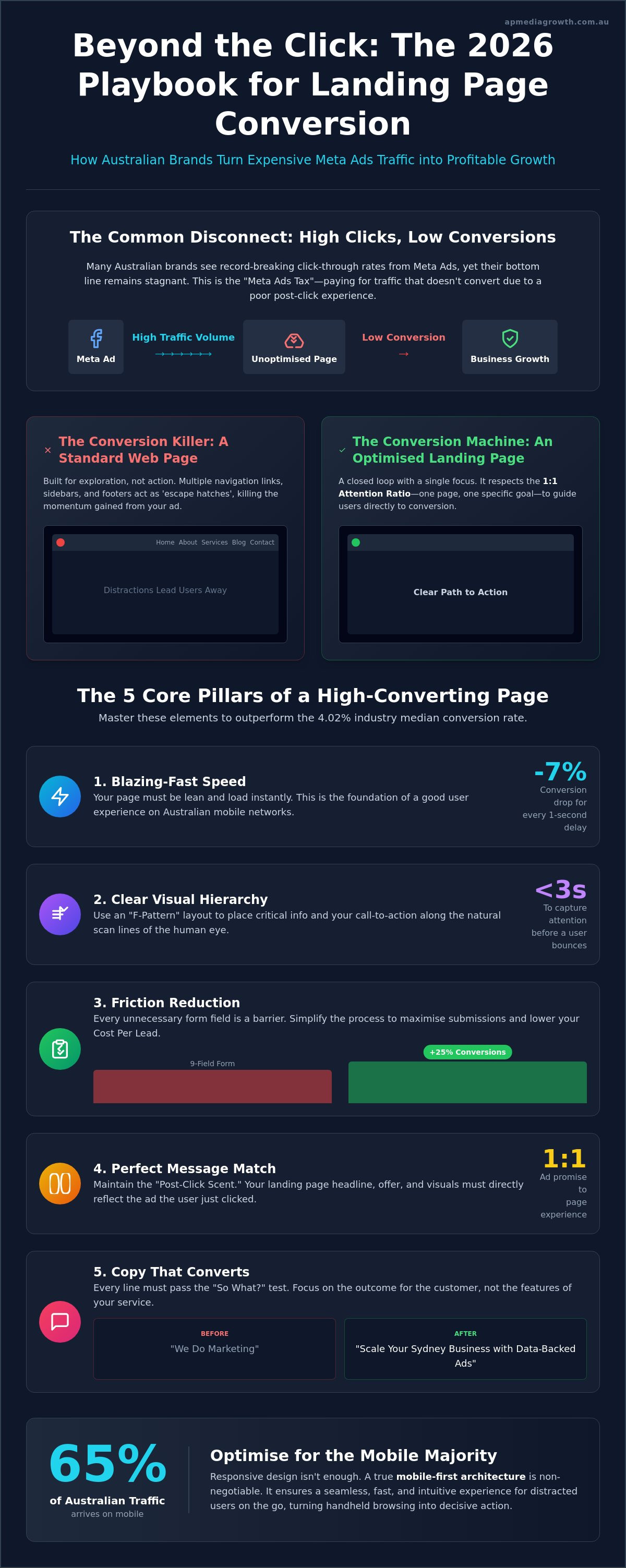
Navigation menus are the primary conversion killers on standard web pages. They act as escape hatches that lead users away from your primary call to action. High-converting pages adhere to the "1:1 Attention Ratio" rule; there is exactly one goal for every one page. By removing headers, footers, and sidebar links, we significantly reduce the cognitive load on the user. This is vital for distracted social media users in Australia who are often browsing on mobile devices while multitasking. They don't want to go on a treasure hunt to find your contact form; they want the specific solution they were promised in your ad creative.
Why 2026 Requires a Performance-First Mindset
The Australian digital landscape has reached a point of total saturation, with 97.1% of the population online as of early 2026. This means the cost of attention has never been higher. When your page fails to convert a visitor, you aren't just losing a lead; you're paying a "Meta Ads Tax" in the form of an inflated Cost Per Acquisition. You cannot afford to send expensive traffic to a page that prioritises "pretty design" over persuasive architecture. Effective landing page conversion optimization treats your page as a sales representative that never sleeps. It uses data-driven layouts and sharp, benefit-led copy to move users from curiosity to commitment with clinical precision.
The Core Pillars of High-Converting Landing Pages in 2026
Successful landing page conversion optimization relies on five structural pillars. If even one is weak, your Meta Ads campaign will struggle to remain profitable. In 2026, the baseline for "good" has shifted. Users are more skeptical and more distracted than ever. You have roughly three seconds to communicate your value proposition before a visitor decides to bounce. This isn't just about aesthetics; it's about a data-driven approach to landing page optimization that respects the user's time and intelligence.
Technical health is your foundation. Research shows that a one-second delay in page load time can decrease conversions by 7%. On Australian mobile networks, where speeds vary, your page must be lean. Beyond speed, you must master visual hierarchy. We utilise the "F-pattern" design, which mirrors how people naturally scan digital content. By placing your most critical information and your primary call to action along these scan lines, you guide the eye toward the conversion point without forcing the user to search for it.
Friction reduction is the next priority. Every additional form field you include acts as a barrier to entry. Statistics confirm that three-field forms convert 25% better than nine-field forms. If you're unsure where your current page is leaking profit, a professional digital growth strategy can identify the specific friction points that are costing you leads.
Crafting a Headline That Stops the Scroll
Your headline must focus on the outcome, not the feature. Instead of "We Do Marketing," try "Scale Your Sydney Business with Data-Backed Ads." Every sub-headline on your page must pass the "So What?" test. If a reader asks that question and your copy doesn't provide an immediate, benefit-led answer, you've lost them. Your value proposition should be a single, punchy sentence that addresses the exact pain point identified in your Meta Ad creative.
Trust Signals That Resonate with Australian Consumers
Australian consumers have a high "BS detector." They look for local markers to verify your legitimacy. Including a local Sydney or Melbourne address and "Proudly Australian" badges can significantly boost trust. Faceless stock photos are a conversion killer in 2026. Use authentic imagery of your team or video testimonials from real Australian clients. Humanising your brand through video allows you to build a rapport that text alone cannot achieve, making the transition from a stranger to a lead feel natural and earned.
Message Match: The Secret to Lowering Your Cost Per Lead
Message match is the functional bridge between your Meta Ad's promise and your customer's reality. In the industry, we refer to this as the "Post-Click Scent." It is the visual and verbal continuity that reassures a visitor they have arrived exactly where they intended. When this scent is broken, users experience "Bounce Shock." This is a moment of cognitive friction that triggers an immediate exit because the page doesn't look or feel like the ad they just clicked. This is why landing page conversion optimization cannot be treated as a standalone task; it must be an integrated extension of your creative strategy.
Relevance is the primary driver of performance. For those seeking a comprehensive guide to landing page optimization, the data consistently shows that high message match scores correlate with lower acquisition costs. Aligning your offer with the specific stage of the buyer's journey is vital. A Top of Funnel (TOFU) ad focusing on "Why Sydney Businesses are Switching to Solar" should lead to an educational, low-friction page. Conversely, Middle of Funnel (MOFU) traffic expects specific pricing or case studies. We often utilise "Dynamic Text Replacement" (DTR) to swap headlines automatically based on the ad's specific copy, creating a personalised experience that drastically improves conversion rates.
Visual Continuity from Meta Ads to Landing Page
Visual continuity acts as a silent trust signal. If your Meta Ad features a specific colour palette, font, or a "Hero" product shot, those exact elements must be prominent on your landing page. Mismatched branding creates subconscious doubt. You shouldn't move from a playful, high-energy video ad to a stuffy, corporate-style page. Maintaining a consistent tone of voice and aesthetic reduces the mental effort required for a user to process your offer, keeping them focused on the conversion rather than questioning your legitimacy.
Synchronising Your Call to Action (CTA)
Synchronising your Call to Action (CTA) is the final piece of the puzzle. If your ad button says "Download Now," your landing page button must mirror that exact phrasing. Avoid the "Offer Bait and Switch" where a promised discount or resource is hidden behind multiple scrolls or a complex, nine-field form. The promise made in the ad must be the first thing the user sees upon landing. Strong message match directly improves the relevance score of your Meta Ads, which reduces your overall advertising costs and makes your digital growth strategy far more efficient.
Optimising for the Australian Mobile Consumer
Mobile isn't just a secondary device; it's the primary touchpoint for Australian consumers. In 2026, mobile devices account for over 60% of total web traffic in Australia. For Meta Ads, this figure often exceeds 90% during the initial discovery phase. Despite this dominance, mobile landing pages convert at only about 58% of the desktop rate. This discrepancy represents a significant profit leak that professional landing page conversion optimization aims to fix. You cannot rely on standard responsive design that simply stacks desktop elements. You need a mobile-first architecture built specifically for the "thumb zone."
Australia's median mobile download speed has reached 122.20 Mbps, making mobile internet faster than fixed broadband in many regions. However, high speeds don't excuse poor technical performance. Local hosting in Sydney is essential to minimise latency for your primary audience. If your page takes too long to respond, your Cost Per Lead will skyrocket before the user even sees your headline. We focus on lean code and optimised assets to ensure your message lands instantly, regardless of the user's connection quality.
The "Above the Fold" Rule for Mobile
On a mobile screen, every pixel is premium real estate. Your headline, value proposition, and a primary CTA must be visible immediately without a single scroll. You shouldn't force users to hunt for the "why" behind your offer. Remove heavy video backgrounds that look impressive on a desktop but destroy mobile load times and consume data. For Sydney-based service businesses, we often implement "Click-to-Call" or "Click-to-WhatsApp" buttons. These direct channels capitalise on the high-intent nature of mobile users who want immediate engagement rather than a delayed email response.
Simplifying Forms for Smaller Screens
Forms are where most mobile conversions die. You must apply the "Fat Finger" test to every interactive element; if a button is smaller than 44x44 pixels, it's a friction point. Research confirms that three-field forms convert 25% better than nine-field forms. In the Australian market, three fields is the absolute sweet spot for lead generation. Use auto-fill and social logins to reduce data entry friction wherever possible. If your current mobile experience feels clunky or slow, it's time to invest in a dedicated website landing page designed for performance. By prioritising the mobile consumer, you turn a high-traffic channel into a high-conversion asset.
Scaling Your Sydney Business with AP Media Growth
Traffic is a vanity metric if it fails to generate revenue. At AP Media Growth, we recognise that a high click-through rate on your Meta Ads is only half the battle. If your post-click experience is disjointed, you are effectively subsidising the platform without seeing a return. We view landing page conversion optimization as a mandatory component of any serious digital growth strategy. Our focus remains on the entire funnel, ensuring that the momentum generated by your ad creative is captured and converted with precision.
Our Performance-Driven Landing Page Framework
Generic templates rarely meet the demands of a sophisticated audience. We develop custom website landing pages designed specifically to handle the nuances of paid social traffic. This isn't a "set and forget" project. Because only 13% of A/B tests produce a statistically significant winner, our approach is built on continuous iteration. We test headlines, hero imagery, and form structures to ensure we are squeezing every drop of value from your ad spend. This disciplined methodology ensures that your landing pages evolve alongside changing consumer behaviours and platform algorithms. We align every technical decision with your long-term business objectives, moving beyond surface-level aesthetics to focus on structural persuasion.
Ready to Stop Wasting Your Ad Spend?
We position ourselves as a specialised consultant for Sydney brands that value transparency and measurable outcomes. We don't offer SEO, and we never make vague, fixed ROI commitments. These "black box" promises often hide a lack of technical depth. Instead, we provide a clear, performance-first partnership that integrates elite Meta Ads management with world-class landing page conversion optimization. We believe in showing you exactly where your investment is going and how it is performing in real-time. If you are tired of high lead costs and low-quality conversions, it is time to shift to a system that respects your bottom line. Book your digital growth strategy session with our Sydney team today and find out how we can transform your landing pages into high-performance sales machines.
Own Your Post-Click Performance
Winning in 2026 requires more than just high-quality ad creative. It demands a seamless transition from the first click to the final conversion point. By mastering the "Post-Click Scent" and prioritising a mobile-first architecture, your brand can bypass the friction that stalls most Australian campaigns. Effective landing page conversion optimization isn't a one-off project; it's a disciplined, ongoing commitment to refining the user experience and reducing cognitive load for your potential customers.
As Sydney-based digital growth specialists, we focus on engineering high-converting Meta Ads funnels that turn expensive traffic into measurable business outcomes. We don't believe in "set and forget" strategies that leave your ROI to chance. Our data-driven approach is built on transparent partnership and a relentless focus on scalable performance. It's time to stop letting your advertising budget leak through the cracks of a generic website or a dated mobile experience. You've done the hard work of capturing attention; now it's time to convert it. Maximise your Meta Ads ROI with our specialised landing page development. We're ready to help you build a repeatable, profitable system for long-term growth.
Frequently Asked Questions
What is a good conversion rate for a landing page in Australia?
A successful conversion rate depends on your specific industry, but the median across all sectors is 4.02% in 2026. High-performance brands in the top quartile generally achieve rates of 11.45% or higher. We focus on moving your results toward that top 25% by refining high-variance elements like your headline and primary call to action.
How much does landing page conversion optimisation cost?
The cost of professional optimisation is based on the complexity of your sales funnel and the volume of traffic you're driving. We view this as a strategic performance investment rather than a flat expense. The objective is to ensure the resulting reduction in your Cost Per Lead significantly outweighs the initial development and testing costs.
Can I just use my existing website as a landing page for Meta Ads?
You can, but it often leads to inefficient ad spend. Standard website pages are designed for exploration and usually contain multiple navigation links that act as escape hatches. For Meta Ads traffic, you need a dedicated environment with a 1:1 attention ratio. This keeps visitors focused on the single offer that triggered their click.
How long does it take to see results from landing page optimisation?
Initial performance lifts often appear within the first few days of launching an improved page. However, true landing page conversion optimization is an iterative process that requires data. It typically takes 30 to 60 days to gather enough statistically significant results to fully refine your messaging and maximise your long-term scalability.
Do I need a different landing page for every ad I run?
Not necessarily, but you must maintain perfect message match. While you don't always need a unique URL for every ad, you should use dynamic elements to ensure the page copy reflects the specific ad creative. For vastly different offers or audience segments, separate pages are essential to avoid "Bounce Shock" and maintain conversion momentum.
What tools do you recommend for landing page A/B testing in 2026?
We recommend platforms that integrate seamlessly with the Meta Pixel and your CRM, such as Unbounce or Instapage. In 2026, AI-driven testing tools have become essential, as AI-generated pages currently show a 37% higher conversion rate compared to human-written controls. The right tool depends on your specific technical requirements and data framework.
How does landing page speed affect my Meta Ads performance?
Speed is a critical factor in your overall return on ad spend. A one-second delay in page load time can decrease your conversions by 7%. On Australian mobile networks, slow pages lead to higher bounce rates and lower ad relevance scores. This increases your costs and makes it harder to scale your digital growth strategy profitably.
Is mobile-first design really that important for B2B companies in Sydney?
Yes, mobile-first design is non-negotiable for B2B brands. With mobile devices accounting for over 60% of total web traffic in Australia, many decision-makers will first encounter your brand on a smartphone. A clunky or slow mobile experience creates immediate friction, often disqualifying your business before a prospect ever views your desktop site or requests a demo.