
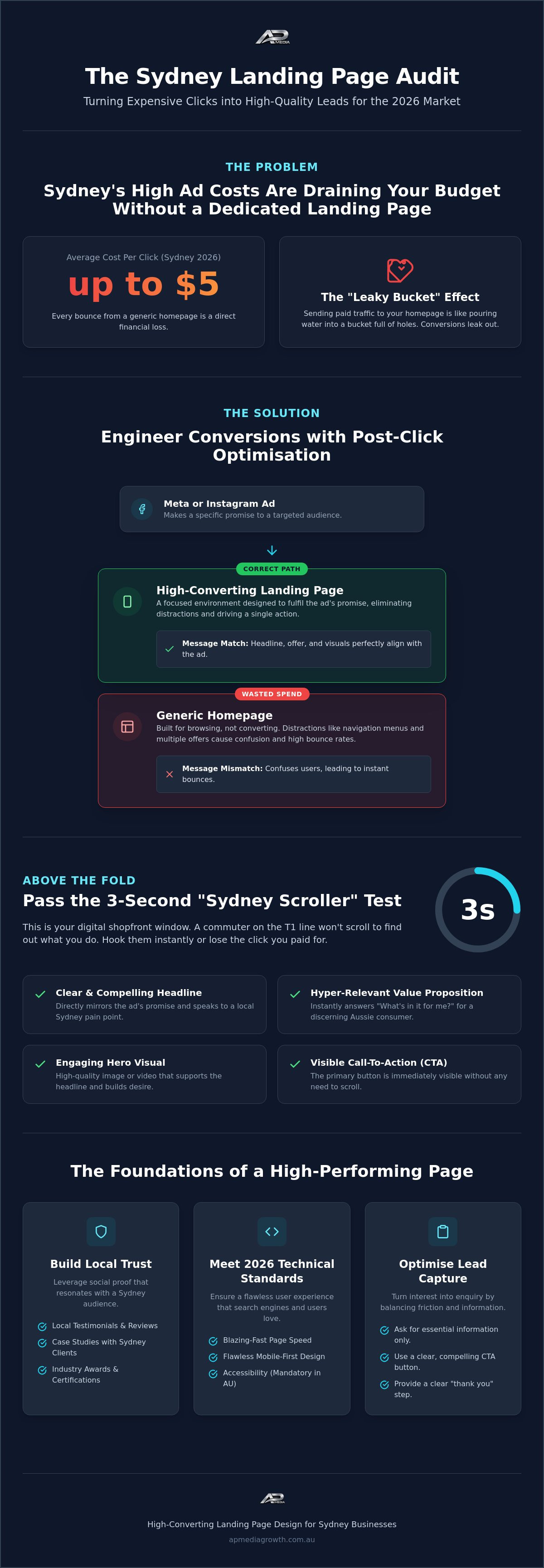
With Sydney's average cost per click reaching up to $5 in 2026, every bounce from your website is more than just a missed opportunity; it's a direct drain on your marketing budget. You've likely felt the frustration of watching Meta and Instagram ad spend climb while lead volume remains stagnant. It's a common reality in our competitive local market where "good enough" in-house designs often fall flat against sophisticated competitors. We understand that you're tired of expensive clicks that don't convert and designs that fail to reflect your brand's true authority.
This article provides a comprehensive audit of your digital assets to ensure your high-converting landing page design Sydney strategy is built for performance rather than just aesthetics. We'll show you how to lower your cost-per-lead and build a scalable system for testing new offers with confidence. We are going to break down the technical benchmarks, trust signals, and mobile-first essentials required to optimise your landing pages into a disciplined, high-pressure sales environment.
Key Takeaways
- Stop treating your homepage as a destination for paid traffic and learn why custom landing pages are the non-negotiable link in a successful Meta Ads strategy.
- Master the "Above the Fold" checklist to ensure your headline and hero section hook the distracted "Sydney Scroller" within the first three seconds.
- Leverage the power of high-converting landing page design Sydney to build immediate trust with local audiences through strategic social proof and 2026 technical standards.
- Optimise your lead capture forms by balancing friction with information to turn expensive clicks into high-quality enquiries without losing the prospect.
- Future-proof your digital assets by aligning with 2026 mobile-first benchmarks and mandatory accessibility requirements now essential for all Australian websites.
The Leaky Bucket: Why Sydney Meta Ads Fail Without Custom Landing Pages
Running Meta Ads in Sydney without a dedicated destination is like pouring premium fuel into a car with a punctured tank. You're paying for the momentum, but the results are leaking out before you reach the finish line. In the 2026 market, a high-converting landing page design Sydney strategy isn't a luxury; it's the fundamental barrier between a profitable campaign and a "donation" to Meta. If you're sending paid traffic to your homepage, you're essentially subsidising the platform's revenue without securing your own.
So, what is a landing page? In a performance context, it is a singular, focused environment designed to fulfil the specific promise made in your ad creative. Sending traffic to a generic homepage is a tactical error because homepages are built for browsing. Australian consumers have moved past the "explore" phase by the time they click an ad. They want immediate relevance. If your ad promises a solution for North Sydney property management but your homepage talks about your company history in Surry Hills, you've lost them in seconds.
Checklist Item 0: Is your destination page 100% aligned with your ad creative? This is the "Message Match" test. If the headline, visual style, and offer don't mirror the ad perfectly, your conversion rate will crater. Discerning Aussie shoppers recognise the disconnect instantly, leading to high bounce rates and wasted spend.
The Cost of a 'Generic' Experience in Sydney
The stakes in the Sydney market are higher than ever. With average cost-per-click (CPC) rates sitting between $3 and $5 as of June 2026, every bounce represents a tangible financial loss. Competition in the CBD and North Sydney is fierce, with savvy brands outbidding anyone who hasn't prioritised conversion rate optimisation. Meta's algorithms also penalise poor user experiences. When your message match is off, your Quality Score drops. This means you pay a premium for the same visibility as competitors who have invested in a high-converting landing page design Sydney approach.
Defining Post-Click Optimisation (PCO)
Post-Click Optimisation is the secret weapon of high-growth Australian brands. It's the disciplined process of refining everything that happens after the click to ensure the highest possible return on ad spend. At AP Media Growth, we view a landing page as a dedicated conversion asset rather than a simple web page. While your website serves your brand's broad needs, your landing page serves the ad's specific objective. We structure the ad-to-page bridge by focusing on three core pillars:
- Eliminating Distractions: Removing navigation menus that tempt users to "wander" away from the offer.
- Singular Objective: Ensuring every element on the page leads toward one specific call to action.
- Technical Precision: Meeting 2026 standards for speed and mobile responsiveness to cater to the Sydney commuter.
This strategic shift from "sending traffic" to "engineering conversions" is what separates market leaders from those just making up the numbers.
The 'Above the Fold' Checklist: Nailing the First 3 Seconds
The "above the fold" area is your digital shopfront's window display. In a city where attention is the scarcest currency, your high-converting landing page design Sydney must pass the "Sydney Scroller" test. This refers to the moment a commuter on the T1 North Shore line or a busy professional in Barangaroo glances at their screen. You have exactly three seconds to prove you have the solution they need. If they have to scroll to understand what you do, you've already lost the click you paid for. Visual hierarchy must lead the eye from the hook to the value, and finally to the action, without a single moment of friction.
Your Unique Value Proposition (UVP) must be hyper-relevant to the local context. Australian consumers value directness and local expertise. For example, a UVP like "Sydney's most reliable emergency plumbing for Eastern Suburbs homes" is infinitely more effective than "We fix pipes." When optimising for social media traffic, this hero section must be the logical conclusion to the conversation started in your Meta ad creative. If the ad promised a specific outcome, that outcome must be the first thing the user sees on the page.
Crafting a Headline That Stops the Scroll
Your headline isn't the place for poetic ambiguity; it's the place for clarity. Use power words that resonate with the Australian market, such as "Proven," "Local," or "Guaranteed." Address the reader's primary pain point within the first five words to ensure immediate resonance. A strong headline for a Sydney business might be: "Secure Your North Sydney Office with 24/7 Monitored Security." This structure identifies the benefit, the location, and the specific service in one punchy declaration. Every word must work toward keeping the user on the page.
The Primary Call to Action (CTA)
The primary CTA is the bridge between interest and enquiry. High-performing buttons in the Sydney market avoid the generic. Never use "Submit." It implies effort and a lack of value. Instead, use benefit-driven micro-copy like "Get My Free Quote" or "Claim My Strategy Session."
- Colour: Use a high-contrast colour that stands out from the background.
- Placement: Ensure the button is visible without scrolling on both mobile and desktop.
- The 'One Goal' Rule: Remove navigation links, social icons, or footer clutter that might leak traffic.
Trust Signals and Social Proof: Winning the Sydney Market
Sydneysiders are notoriously hard to impress. In a market where 81% of consumers demand brand trust before making a purchase, your landing page must act as a digital handshake. High-converting landing page design Sydney isn't just about the layout. It's about the psychological safety you provide. If your page feels like a generic template, you're triggering the "Sceptical Sydneysider" reflex. This is particularly true in 2026, as cost-of-living pressures make consumers more discerning about where they spend their money. They aren't just looking for a service; they're looking for a reason to trust you with their diminishing disposable income.
One of the fastest ways to kill trust is using stock photography. We've all seen the smiling office workers in a generic glass building that clearly isn't in the CBD or North Sydney. Real photography beats stock images every time because it proves you exist in the same reality as your customer. Show your actual team, your local office, or your work being performed in recognisable Sydney suburbs. This visual authenticity bridges the gap between a digital ad and a real-world business. It's a simple shift that transforms you from a faceless entity into a local authority.
Localised Social Proof Strategies
Social proof is only effective if it feels relevant. If you're targeting businesses in Parramatta, a testimonial from a client in London carries very little weight. Use Sydney-based case studies and feature logos of local organisations you've partnered with. Video testimonials are especially powerful for high-ticket services, as they are much harder to fake than written text. They humanise your brand and provide the peer recommendations that 2026 consumers value more than traditional marketing.
- Recency: Ensure your reviews are from the last six months. Outdated proof suggests a stagnant business.
- Verifiability: Link to third-party platforms where your reviews can be verified independently.
- Demographic Match: Use testimonials from people who reflect your target Sydney audience's pain points and aspirations.
The Role of Authority and Credentials
Establishing authority requires more than just claims. It requires evidence. Displaying industry memberships, such as the Australian Marketing Institute or local chambers of commerce, provides a layer of professional accountability. Security badges are also critical in 2026 to mitigate conversion anxiety around data privacy. To ensure your brand remains consistent across the entire funnel, your landing page must align with your broader Meta Ads for Sydney Businesses strategy. When your ad's promise of local expertise is backed by visible credentials on the page, the trust barrier begins to dissolve. This alignment creates a seamless transition that reinforces your position as a reliable growth partner.
The Technical Audit: Speed, Mobile, and 2026 Standards
A visually stunning design is a liability if it fails to load before a prospect loses interest. In the high-stakes environment of high-converting landing page design Sydney, technical performance is the silent engine of your ROI. With nearly 94% of all Australian internet users accessing the web via smartphones in 2026, your page is likely being judged on a mobile screen during a morning commute. If the technical foundation is weak, your Meta Ads budget is simply subsidising your competitors who have prioritised a frictionless experience.
Beyond speed, 2026 standards mandate that all Australian websites meet Web Content Accessibility Guidelines (WCAG) 2.2 Level AA. This is no longer a "nice to have" feature; it is a legal requirement under the Disability Discrimination Act 1992. Ensuring your landing page is accessible to all users isn't just about compliance. It expands your reachable market and signals brand maturity to a discerning Sydney audience. Your technical audit must also confirm that your Meta Pixel and tracking API are firing correctly. Without accurate data, you cannot optimise your campaigns or scale your winning offers.
Speed as a Conversion Factor
In the Sydney market, speed is a non-negotiable conversion factor. Research indicates that a mere one-second delay in page load time can cut your conversions by 7%. This correlation between load time and bounce rate is absolute; as load time increases, the probability of a user abandoning the page skyrockets. To maintain your edge, your audit should include:
- Image Optimisation: Utilising next-gen formats like WebP to ensure high-quality visuals don't bloat your load times.
- Local Server Location: Ensuring your hosting is Australia-based to reduce latency for local users.
- Code Minification: Stripping away unnecessary characters from your HTML, CSS, and JavaScript to streamline delivery.
Mobile UX Checklist
The "Sydney Scroller" expects a page that responds instantly to touch. Your mobile UX must pass the "Fat Finger" test, ensuring that all buttons and form fields are easily tappable without accidental clicks. Testing your page on the latest iPhone and Android models is essential to account for varying screen sizes and browser behaviours.
- Thumb-Friendly Forms: Reducing the number of fields and using mobile-optimised input types (like numeric keypads for phone numbers).
- Sticky CTAs: Keeping your primary call to action visible or easily accessible as the user scrolls.
- Responsive Typography: Ensuring text remains legible without the need for pinching or zooming.
Beyond external marketing, specialised providers like fokus digital GmbH illustrate how mobile-first design is also being applied to internal tools like employee apps to streamline workflows in sectors such as care and social services.
Optimising the Lead Capture: From Interest to Enquiry
The lead capture form is the final hurdle in your customer's journey. After you've successfully hooked the visitor with a sharp headline and built authority through social proof, this is where you convert that fleeting interest into a tangible enquiry. In the context of high-converting landing page design Sydney, your form must strike a delicate balance between gathering necessary data and respecting the user's time. If the friction is too high, your conversion rate will suffer; if it's too low, your sales team will waste hours chasing unqualified leads who aren't ready to buy.
Successful lead capture in 2026 requires a shift from "data collection" to "user experience." Discerning Sydney consumers are increasingly protective of their personal information. They won't hand over their details unless the value exchange is crystal clear. This is why every element of your form, from the number of fields to the micro-copy on the submit button, must be intentionally engineered. A high-performing landing page isn't a static asset. It's a dynamic sales tool that requires an "Always-Be-Optimising" mindset to stay ahead of the competition in the CBD and beyond.
Reducing Form Friction
The "Rule of 3" remains a powerful benchmark: asking for more than three pieces of information can significantly reduce completion rates. For simple lead magnets, a name and email address are often enough. However, for Sydney B2B leads or high-ticket services, you may need more context to qualify the prospect. Multi-step forms are the superior solution here. By breaking the enquiry process into two or three logical stages, you reduce the perceived effort and increase the likelihood of completion.
- Progress Bars: Use visual indicators to show users they are nearly finished.
- Privacy Assurance: Ensure your privacy policy is clearly linked and easy to find; this is a non-negotiable trust factor for 2026 compliance.
- Smart Fields: Use auto-fill capabilities to make the process as fast as possible for mobile users.
Post-Conversion Strategy
The "Thank You" page is arguably the most undervalued real estate in your entire marketing funnel. Don't treat it as a dead end. Instead, use it to provide immediate next steps, such as a calendar link to book a discovery call or a high-value case study. Speed-to-lead is a critical performance metric for Sydney businesses. If your sales team doesn't reach out within minutes of an enquiry, the prospect's interest will rapidly cool. Integrating your landing page with a robust CRM ensures that every lead is tracked and assigned instantly. Setting up immediate email or SMS notifications for your sales team can be the difference between a closed deal and a lost opportunity. By partnering with a digital growth strategy expert, you can scale these results through a repeatable, data-driven system that turns every click into a potential conversation.
Future-Proofing Your Sydney Conversion Strategy
The 2026 digital landscape in Sydney leaves no room for guesswork. A high-converting landing page design Sydney isn't just about aesthetic appeal; it's a precision-engineered tool designed to convert expensive clicks into measurable revenue. By aligning your destination pages with your Meta ad creative, meeting 2026 accessibility standards, and removing friction from your lead capture forms, you stop the leak in your marketing bucket. You transform your website from a passive brochure into a disciplined sales asset that works as hard as your team does.
Scaling a business in a competitive market requires more than just high traffic volume. It demands a repeatable system for testing offers and a strategic partner who understands the nuances of the local landscape. As Sydney-based performance specialists and Meta Ads experts, we focus on data-driven growth strategies that deliver tangible results. Don't let your ad spend go to waste on pages that fail to convert. Book Your Free Landing Page Audit with Sydney's Growth Experts today and start turning your digital traffic into profitable conversions. Your next phase of growth is just one audit away.
Frequently Asked Questions
How much does high-converting landing page design cost in Sydney?
The investment for a professional landing page varies based on the strategic depth and technical complexity your business requires. A high-converting landing page design Sydney project involves more than just aesthetics; it includes market research, psychological copywriting, and performance-first development. You should evaluate the cost against your projected lead value and the reduction in wasted ad spend that a high-performing asset provides.
Why is my landing page getting clicks but no conversions?
This usually indicates a "message match" failure or excessive friction on the page itself. If your Meta ad promises a specific solution but your landing page delivers generic information, users will bounce immediately. Technical issues like slow mobile load times or a confusing lead capture form also prevent interested prospects from completing their enquiry.
Do I need a new website or just a dedicated landing page for my ads?
You don't need to rebuild your entire website to improve your ad performance. For paid social campaigns, a dedicated landing page is actually superior to a standard website because it removes navigation distractions and focuses the user on a single action. Websites are designed for browsing, while landing pages are engineered specifically for conversion.
What is a good conversion rate for Sydney businesses on Meta Ads?
While benchmarks vary by industry, the median conversion rate for a dedicated landing page is approximately 4.02% in 2026. The top 25% of performers often see conversion rates of 11.45% or higher. If your current results are below the 4% mark, it's a clear signal that your landing page design is the primary bottleneck in your sales funnel.
How long does it take to see results from a new landing page design?
You can see measurable results almost as soon as your traffic starts flowing. Unlike organic strategies, paid traffic provides immediate data on how users interact with your new design. This allows for rapid feedback and allows you to make data-driven optimisations to your high-converting landing page design Sydney strategy within days of launching.
Can I use a template for my Sydney landing page design?
Templates are an option, but they often lack the "Sydney-centric" authority and technical precision required to beat sophisticated local competitors. Custom designs allow you to integrate specific local trust signals and meet 2026 accessibility standards that generic templates often ignore. To achieve a top-tier conversion rate, your page must be tailored to your specific audience's pain points.
What are the most important trust signals for Australian consumers?
Real photography of your local team and Sydney offices is far more effective than stock imagery for building trust. You should also feature verifiable reviews from local clients and display industry certifications or memberships. In 2026, showing compliance with Australian web accessibility standards is also a major marker of a professional and dependable brand.
Does landing page speed really affect my Meta Ads performance?
Yes, page speed is a direct factor in your Meta Ads quality score and overall ROI. A one-second delay in load time can cut conversions by 7%, leading to higher bounce rates and increased costs per click. Meta's algorithm penalises slow-loading pages because they provide a poor user experience, making technical speed a vital part of your conversion strategy.