

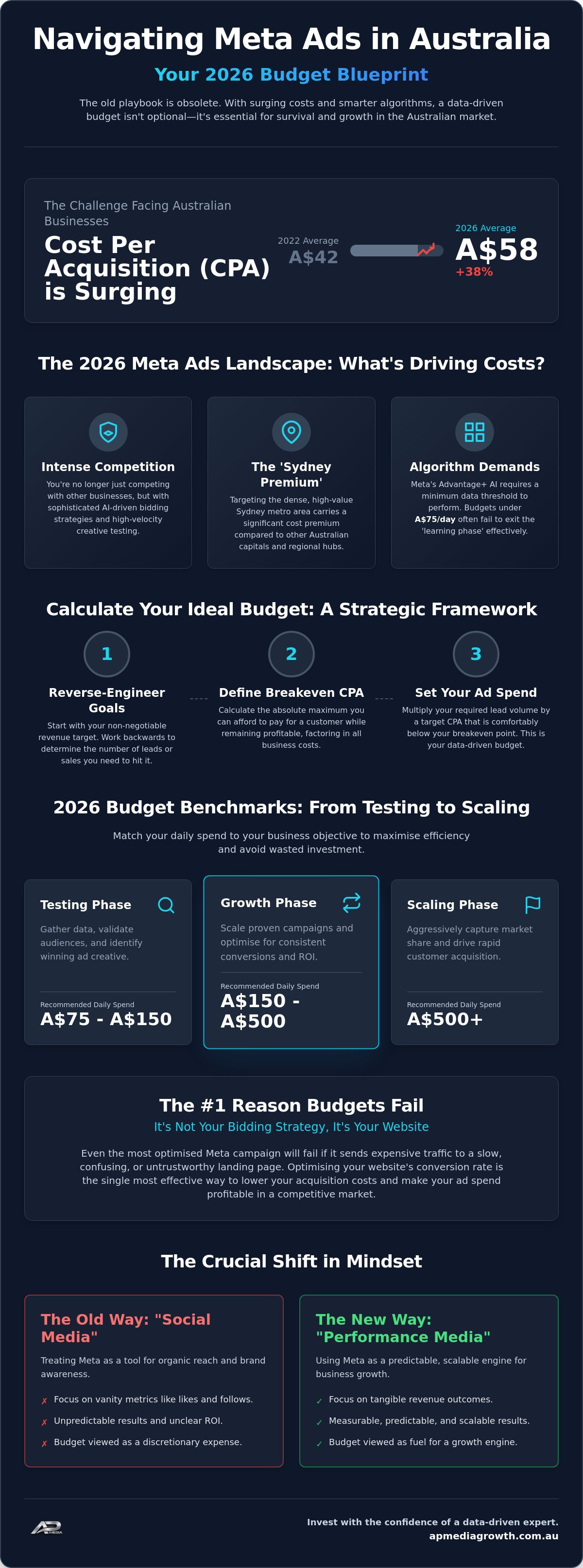
What if the reason your digital growth has stalled isn't that you're spending too little, but that you're funding a strategy designed for 2022? With Cost Per Acquisition (CPA) in Australia surging by 38% to an average of A$58 this year, the question of how much to spend on meta ads 2026 has become a high-stakes calculation rather than a guess. You're likely feeling the pressure of rising lead costs and the challenge of justifying every cent of ad spend to your stakeholders when the algorithm feels like a moving target.
We understand the frustration of watching your margins thin as competition intensifies across Sydney and beyond. This guide provides the exact frameworks and benchmarks needed to calculate a profitable Meta Ads budget tailored for the current Australian market. You'll discover why a minimum of A$75 per day is now the baseline for data efficiency, how to scale your spend based on specific revenue targets, and why your website landing page is actually the most influential factor in your budget's success. It's time to stop guessing and start investing with the confidence of a data-driven expert.
Key Takeaways
- Learn the exact framework to calculate how much to spend on meta ads 2026 by reverse-engineering your specific revenue goals and lead requirements.
- Compare your current investment against updated 2026 benchmarks for Australian businesses, ranging from lean startup tests to aggressive scaling strategies.
- Discover why optimising your website landing page is the most effective way to lower your acquisition costs in a competitive digital auction.
- Master the distinction between testing and scaling phases to protect your budget from being drained by inefficient targeting.
- Understand the strategic advantage of specialist management in navigating the 'Sydney Premium' and complex local market dynamics.
The 2026 Meta Ads Landscape in Australia: What’s Driving Costs?
The Australian digital auction has evolved into a precision-based environment where the cost of attention is dictated by ruthless efficiency. In 2026, competition for the Australian consumer's feed is at an all-time high. This isn't just about more businesses joining the platform; it's about the sophistication of the players involved. When you're deciding how much to spend on meta ads 2026, you're competing against brands that have fully integrated AI-driven bidding and high-velocity creative testing. This saturation has pushed the average Cost Per Acquisition (CPA) up by 38% year-on-year, meaning your budget must work harder than ever to secure a conversion.
For businesses operating in New South Wales, the 'Sydney Premium' is a tangible reality. Targeting the Sydney metropolitan area often results in higher costs compared to regional hubs or other capital cities. This is driven by the density of high-value consumers and the concentration of advertisers vying for the same eyeballs. Local market dynamics in 2026 require a more nuanced approach to bidding. You can't simply set a national average and expect to win in the Sydney market. You need a budget that accounts for these regional fluctuations to ensure your ads actually reach your intended audience without being outbid by larger competitors.
Meta's Advantage+ algorithms have fundamentally changed budget requirements. These AI systems require a significant volume of data to exit the 'learning phase' and begin optimising effectively. If your daily spend is too low, the algorithm won't gather enough signals to identify your ideal customer, leading to wasted spend and poor performance. Successful Australian brands are now leaning into these automated systems, but they're doing so with a clear understanding of the underlying online advertising models that dictate cost and reach. To succeed, your creative must also align with current Australian consumer sentiment, which prioritises authenticity and trust over traditional, high-gloss sales pitches.
Inflationary Pressures on Australian CPMs
The cost of reaching a thousand Australians (CPM) has seen a steady rise, with the 2026 average now sitting between A$19 and A$22. In competitive sectors like finance or professional services, this can easily exceed A$30. The myth of 'cheap' traffic has officially been retired. To protect your margins, you must focus on conversion efficiency. Every dollar spent on Meta must be supported by a high-performing website landing page that turns that expensive traffic into revenue. Without this, rising platform costs will eventually make your campaigns unsustainable.
The Shift from 'Social Media' to 'Performance Media'
There's been a decisive shift away from organic social media management toward dedicated performance media. Australian businesses are realising that organic reach is no longer a viable growth lever for scaling a company. Instead, they're reallocating those 'content creation' budgets into paid Meta strategies that offer measurable, predictable results. Performance media is the primary driver for Sydney SMBs in 2026, shifting the focus from vanity metrics like likes and follows to tangible revenue outcomes. When considering how much to spend on meta ads 2026, view your budget as fuel for a growth engine rather than a discretionary marketing expense.
Calculating Your Ideal Meta Budget: A Strategic Framework
Determining how much to spend on meta ads 2026 requires a shift from arbitrary figures to a reverse-engineered financial model. You shouldn't start with what you're willing to lose; you should start with what you need to earn. By identifying your revenue targets for the year, you can work backwards through your conversion rates to find the necessary traffic volume. This pragmatic approach ensures your budget is a calculated investment rather than a hopeful expense. It's also vital to account for the 10% Australian GST and potential currency fluctuations that impact your total billing, as these hidden costs can quickly erode your planned margins.
Before launching, you must calculate your breakeven Cost Per Acquisition (CPA). This is the maximum amount you can spend to acquire a customer before you start losing money on the transaction. For a Sydney-based service business, this means factoring in your labour, overheads, and desired profit margin. Only once you know this number can you objectively judge if the 2026 auction prices are viable for your business model. If your margins are too thin to support current auction costs, your focus should shift to increasing your average order value or lifetime customer value before scaling your spend.
Step 1: Define Your Goal (Lead Gen vs. E-commerce)
Your industry dictates your benchmarks. In the Sydney service sector, Cost Per Lead (CPL) typically ranges from A$80 to A$150 for professional services like real estate or legal. E-commerce brands, meanwhile, are seeing a shift where a Return on Ad Spend (ROAS) of 3x to 4x is considered a strong performance in the current competitive climate. According to the latest Australian social media statistics, the sheer volume of active users across Facebook and Instagram provides the scale needed, but your budget must align with the typical Australian sales cycle, which often requires multiple touchpoints before a final decision is made.
Step 2: The 3x-5x Rule for Testing
The initial phase of any campaign is about buying data, not just sales. During this testing phase, your first A$2,000 will look significantly different from your scaling budget. You need to apply the 3x-5x rule: your daily budget for an ad set should be at least three to five times your target CPA. This is essential to provide Meta’s AI with enough signals to exit the learning phase quickly. Mathematical necessity dictates that Australian ad sets require a specific volume of weekly conversion events to move beyond algorithmic guesswork and into stable, predictable performance. If you're struggling to find that stability, a tailored Digital Growth Strategy can help align your spend with these technical requirements.
2026 Budget Benchmarks: From 'Starting Out' to 'Scaling Hard'
Deciding how much to spend on meta ads 2026 depends heavily on your current growth stage and your ability to absorb the rising costs of the Australian auction. We categorise spend into three distinct tiers. The 'Lean Startup' budget sits between A$1,500 and A$3,000 per month. While this is the absolute floor, it's increasingly difficult to maintain. Research indicates that a minimum of A$75 per day, or roughly A$2,300 per month, is now required to provide Meta’s algorithm with enough data to exit the learning phase effectively. If you're spending less than this, you aren't just being frugal; you're likely starving your campaigns of the data they need to survive.
The 'Scaling Growth' phase, ranging from A$5,000 to A$15,000 per month, is the sweet spot for many Sydney SMBs. At this level, you have the financial breathing room to test multiple creative formats across Facebook and Instagram while maintaining a consistent 'always-on' presence. For market leaders spending upwards of A$30,000 monthly, the challenge shifts to creative fatigue. These budgets require a high volume of fresh assets to prevent performance from dipping. At this scale, we often see a budget split of 60% for direct response and 40% for brand authority to ensure long-term sustainability in the Australian market.
Industry-Specific Benchmarks for Australia
Your industry significantly dictates your entry price. Competitive sectors like finance and real estate face much higher hurdles than retail. When planning your 2026 investment, use these benchmarks as a guide for your projected costs.
| Industry Sector | Expected CPL/CPA (A$) | Average CPM (A$) |
|---|---|---|
| Finance & Insurance | A$150+ | A$30+ |
| Real Estate | A$80 – A$150 | A$22 – A$28 |
| Professional Services | A$80 – A$150 | A$20 – A$25 |
| E-commerce & Retail | A$40 – A$80 | A$15 – A$22 |
| Home Services | A$40 – A$80 | A$18 – A$24 |
Seasonal Budgeting in the Australian Calendar
The Australian market has unique seasonal peaks that can blow out your CPA if you aren't prepared. The 'End of Financial Year' (EOFY) period in June sees a massive spike in ad costs as B2B brands and retailers dump remaining budgets into the auction. Similarly, the period from Black Friday through to Boxing Day requires a significantly higher daily spend just to maintain your share of voice. Conversely, the Australian summer holiday slump in January offers a strategic opportunity. While many competitors go dark, CPMs often soften, making it a cost-effective time for brand-building and nurturing leads before the February rush begins. Consistent, data-backed spending is almost always more efficient than erratic 'stop-start' budgeting.
Why Your Spend Fails: The Landing Page and Creative Gap
Calculating how much to spend on meta ads 2026 is only half the battle. You can deploy a perfectly calibrated budget into the Australian auction, but if your post-click experience is flawed, you're essentially funding a leaky bucket. Many Sydney businesses mistakenly believe that increasing their spend will fix a plateau in results. In reality, throwing A$10,000 at a website that doesn't convert is just an expensive way to prove your site isn't working. Post-click optimisation is the most underrated lever for lowering your Meta costs because it increases the value of every single visitor you've already paid for.
Creative fatigue is another silent budget killer in 2026. Australian audiences have become incredibly adept at spotting and ignoring traditional advertisements. There's a growing demand for authentic content that feels native to the platform. This is why video ads, particularly Reels, are currently driving lower CPMs in the AU market. They offer a more engaging, less intrusive way to capture attention. If your creative strategy hasn't shifted toward short-form, human-centric video, you're likely paying a premium for static images that no longer resonate with a savvy local audience.
The Landing Page: Your Secret Budget Weapon
Your conversion rate is the ultimate multiplier of your ad spend. Consider this: a modest 2% increase in your landing page conversion rate can effectively halve your acquisition costs without you having to touch your Meta dashboard. For the Sydney commuter browsing on a train or during a quick lunch break, speed and clarity are non-negotiable. If your page takes more than two seconds to load, you've lost the lead before the first headline even appears. Investing in a specialised website landing page is often the most profitable move you can make to protect your media investment.
Creative Strategy for 2026
The 2026 landscape is dominated by Reels and User-Generated Content (UGC). In the Australian market, high-production value commercials often lose to lo-fi content filmed on a smartphone. This isn't because Australians don't appreciate quality; it's because they value transparency and relatability. Your budget must include a dedicated creative testing allocation, typically 10% to 20% of your total spend, to experiment with different hooks and formats. This data-driven approach allows you to identify winning assets early, ensuring your main budget is only ever spent on creative that has already proven its ability to stop the scroll. If you want to stop wasting your budget and start scaling, it's time to build a Digital Growth Strategy that prioritises performance over fluff.
Maximising ROI: Partnering with a Sydney Growth Agency
Viewing management fees as a sunk cost is a fundamental mistake for businesses aiming for scale. In the 2026 landscape, professional management is an investment in capital efficiency. A specialised consultant ensures that every dollar of your budget is deployed with surgical precision, preventing the common pitfalls of algorithmic waste and audience saturation. When you are determining how much to spend on meta ads 2026, you must also factor in the cost of the expertise required to navigate a high-stakes auction where a single misstep can drain thousands of dollars in hours.
There is a critical distinction between a 'Social Media Manager' and a 'Paid Media Specialist'. A social media manager typically focuses on brand aesthetics, engagement, and community management. While valuable for brand sentiment, these metrics don't necessarily correlate with revenue. A paid media specialist, however, is a data-driven expert focused on the mechanics of growth. At AP Media Growth, we structure campaigns to move beyond vanity metrics like likes and shares. We prioritise actual business revenue, reverse-engineering our strategies from your profit margins to ensure your Meta spend is a sustainable growth lever rather than a discretionary expense.
Why Specialisation Beats 'All-in-One' Agencies
The Australian market is littered with 'Jack of all trades' agencies that offer everything from SEO to email marketing. The danger here is a lack of depth. We explicitly exclude SEO from our services because we believe that immediate, measurable growth comes from mastering the paid auction. By focusing exclusively on Meta Ads and Digital Growth Strategy, we provide a level of strategic authority that generalist agencies cannot match. Our approach is built on transparency and pragmatic results, ensuring you aren't paying for organic 'fluff' that doesn't impact the bottom line. For more on our specific methodology, see our guide on Meta Ads for Sydney Businesses.
How to Scale Your Spend Safely
Scaling a budget in 2026 requires more than just sliding a bar to the right. You must choose between vertical scaling, which involves increasing the budget of winning ad sets, and horizontal scaling, where you launch new campaigns to test different audiences or creatives. To avoid resetting the learning phase for Australian ad sets, a disciplined rule of thumb is to increase your budget by no more than 20% every 48 hours. This controlled urgency allows the algorithm to adjust without losing the optimisation it has already achieved. If you're unsure how much to spend on meta ads 2026 to hit your next revenue milestone, it's time to talk to a partner who understands the nuances of the Sydney market. Ready to scale? Book a growth strategy session with AP Media Growth.
Future-Proofing Your 2026 Meta Investment
Navigating the Australian digital landscape requires moving beyond guesswork and embracing a performance-first mindset. Success in the current auction is no longer about who spends the most, but who converts the most efficiently. By reverse-engineering your revenue targets and prioritising a high-converting landing page, you can ensure your budget drives actual business growth rather than just platform impressions. Understanding how much to spend on meta ads 2026 is the first step toward reclaiming your margins in an increasingly competitive market.
As Sydney-based specialists, we focus on data-driven growth strategies that turn expensive traffic into measurable revenue. We don't deal in organic fluff; we build repeatable systems designed for scalability. It's time to stop funding a leaky bucket and start investing with the confidence of a strategic partner. Scale your brand with a tailored 2026 Meta Ads strategy. Your business growth is within reach when you pair the right budget with a disciplined, expert system.
Frequently Asked Questions
What is the absolute minimum I should spend on Meta ads in 2026?
The absolute minimum you should spend is A$75 per day, which totals roughly A$2,300 per month. This figure is the baseline required for Meta's AI to gather enough signals to exit the learning phase effectively. If you spend less, your campaigns will likely remain in a state of perpetual guesswork, leading to higher costs and inconsistent performance for your Australian business.
How much do Facebook ads cost per click in Australia?
The median cost per click (CPC) in Australia is currently A$1.70. However, this varies significantly across sectors; you might see clicks as low as A$0.75 in industries like food and beverage, while competitive sectors like finance can reach A$5.30. When calculating how much to spend on meta ads 2026, use these benchmarks to estimate the traffic volume your budget will actually generate.
Is it better to spend more on Instagram or Facebook in 2026?
Budget allocation should follow where your specific audience engages, though Instagram Stories currently offer CPCs roughly 45% cheaper than the standard Feed. While Facebook remains a powerhouse for high-intent lead generation among older demographics, Instagram Reels are driving the lowest overall CPMs for brand awareness. A blended approach is usually best, allowing Meta's Advantage+ systems to find the most efficient placement for your creative.
How long does it take to see results from a new Meta ads budget?
Expect to wait at least two to four weeks to see meaningful initial results from a new campaign. Meta’s algorithm requires roughly 50 conversion events per week, per ad set, to stabilise its targeting and move beyond the learning phase. While you might see some early wins, the first month is primarily about buying data. Real scalability and consistent ROI usually become evident after the three month mark.
Should I include my management fee in my total ad spend budget?
You should treat your management fee as a separate strategic investment rather than part of your media spend. Ad spend is the fuel you pay directly to Meta, while the fee covers the expertise required to ensure that fuel isn't wasted. Mixing the two can lead to confusion when calculating your true ROAS and performance benchmarks. Think of the fee as the insurance policy for your media investment.
Does a higher budget guarantee better results on Meta?
A higher budget does not guarantee better results; it simply accelerates your current outcome. If your creative is failing or your website doesn't convert, a larger budget will only lose money faster. You must achieve efficiency at a smaller scale before attempting to push more volume through the system. Scaling a broken strategy is the quickest way to drain your capital in the Australian market.
How do I know if my Meta ad spend is being wasted?
Your spend is being wasted if your campaigns are stuck in the 'learning limited' phase or if you have a high click-through rate but zero conversions. This often points to a disconnect between your ad and your landing page. If you're paying for traffic that leaves your site immediately, your budget isn't the problem; your post-click experience is likely the point of failure.
What is a good ROAS for Australian eCommerce in 2026?
A return on ad spend (ROAS) of 3x to 4x is considered a strong benchmark for Australian eCommerce in 2026. While some niche brands achieve higher, the 38% year-on-year increase in acquisition costs makes a 4x return a sign of a very healthy campaign. Always focus on your specific 'breakeven ROAS' first to ensure your Meta strategy is actually contributing to your bottom line profit.