

Why are you still paying a "LinkedIn tax" of $15 per click when your ideal executive prospects are scrolling Instagram during their morning commute? Many Australian B2B marketers have been burnt by "junk" leads from standard Facebook forms or felt the sting of exorbitant LinkedIn ad costs that devour margins. It's a common frustration; you want high-quality enquiries, but you're often left with a pipeline full of prospects who never pick up the phone. We understand that the goal isn't just more traffic. It's a repeatable system for filling the sales funnel with genuine opportunities.
This article will show you how to master meta ads for b2b lead generation by transforming the platform into a high-octane engine for qualified prospects. We'll move past basic demographic targeting to leverage the 2026 Australian growth strategy. You'll learn how AI-powered Advantage+ campaigns are currently delivering a 40% lower cost per lead and why the Meta Conversions API is now a non-negotiable part of your technical stack. We are breaking down the exact framework required to achieve a lower cost-per-acquisition than LinkedIn while ensuring your sales team only speaks with high-intent decision-makers.
Key Takeaways
- Learn how to transition from broad consumer tactics to a behavioural targeting model that makes meta ads for b2b lead generation a predictable revenue driver.
- Discover the framework for using your CRM data to seed the Meta algorithm, allowing you to reach decision-makers even when they aren't actively searching.
- Understand why specialised landing pages are essential for qualifying high-ticket prospects and eliminating the "junk" leads common with standard instant forms.
- Master a creative-first strategy where your ad copy and visuals act as a secondary filter to ensure only genuine executive prospects enter your pipeline.
- Shift your focus from surface-level metrics like lead volume to measurable outcomes like cost-per-qualified-opportunity and sales pipeline growth.
Beyond the "B2C Trap": Why Meta Ads for B2B Lead Generation Require a Strategic Pivot
Many Australian firms fall into a common trap by treating Facebook and Instagram as digital billboards for consumer goods. They assume that high-level decision-makers leave their professional challenges at the office door. This narrow view is why most campaigns fail before they even launch. Successfully executing lead generation on Meta requires acknowledging that a CEO is still a person with business problems, even when they're scrolling through their personal feed on a Saturday morning. The platform has evolved from a social network into a behavioural targeting powerhouse.
The core difference lies in the "Intent Gap". On search engines, users are actively hunting for a solution. On Meta, you are generating demand. You aren't waiting for a prospect to type a query; you're interrupting their day with a value proposition so sharp it demands attention. By 2026, the reality is that Meta’s algorithm has become far more efficient at identifying professional buyers than manual interest targeting ever was. Relying on outdated "Job Title" filters is a recipe for stagnation. Modern meta ads for b2b lead generation succeed because they use creative signals to find the person behind the screen who is currently grappling with a specific operational bottleneck.
The Myth of the "Work-Life" Divide
The idea that executives don't use social media for business is a relic of the past. Industry data indicates that CEOs and procurement officers are active on Meta platforms for over 45 minutes every day. This "downtime" represents a strategic opening for your brand. When a prospect is in a relaxed state, their psychological barriers to new ideas are often lower than when they're buried under a mountain of emails. We've shifted our focus from simply targeting a job title to targeting a person with a problem. This approach allows you to build trust and authority before they even realise they're being marketed to.
Meta vs. LinkedIn: The 2026 ROI Comparison
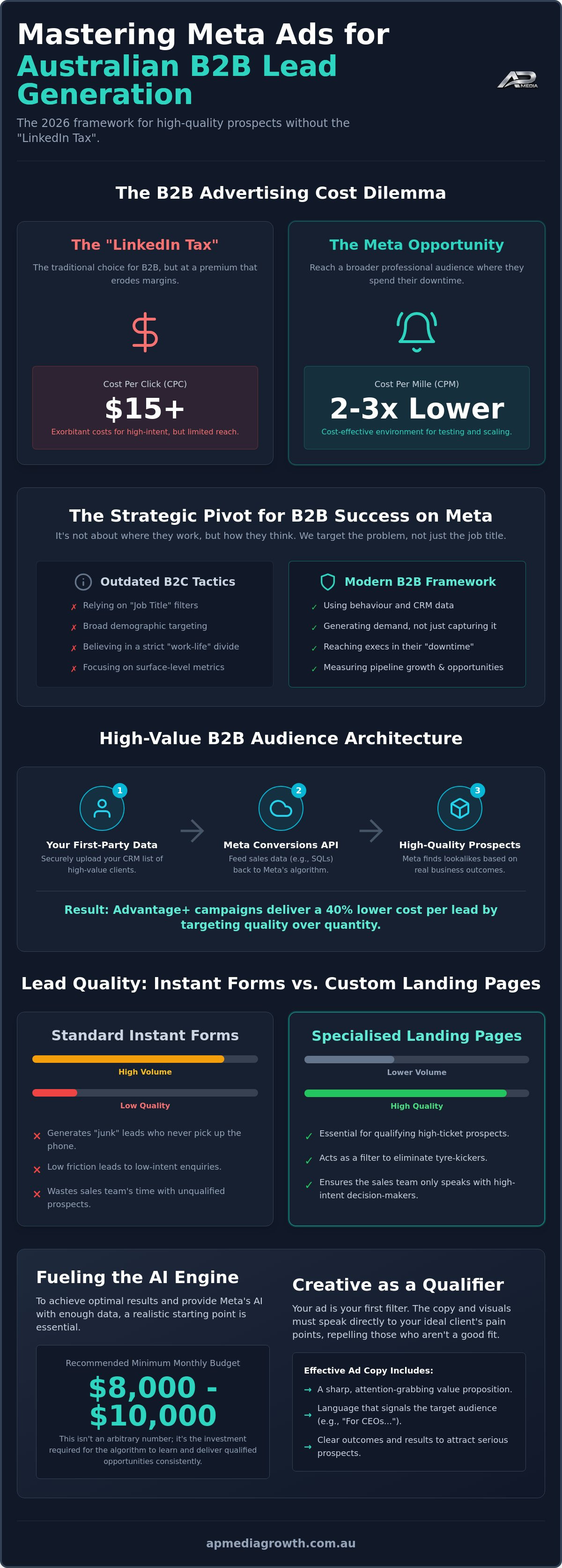
LinkedIn has long been the default for B2B, but the "LinkedIn tax" is becoming harder to justify for many growing Australian businesses. Meta’s CPMs are often two to three times lower than LinkedIn’s, providing a significantly more cost-effective environment for testing and scaling. While LinkedIn is excellent for high-intent targeting, Meta excels at reaching a broader professional audience at a fraction of the cost. To make this work, you need a realistic monthly budget of at least $8,000 to $10,000. This isn't an arbitrary number; it's the minimum required to provide Meta’s AI with enough data to optimise your campaign effectively. When used correctly, Meta acts as the primary engine for filling your pipeline, with LinkedIn often relegated to a secondary retargeting layer to close the deal.
Audience Architecture: Building a High-Value B2B Targeting Framework
Targeting for meta ads for b2b lead generation has fundamentally shifted. It's no longer about guessing which trade magazines a CFO reads or manually selecting every job title variation in the Ads Manager. In 2026, we build audience architecture based on hard data rather than demographic assumptions. The most potent tool in your arsenal isn't an interest category; it's your own first-party data. By seeding the algorithm with your actual customer list, you provide the machine with a blueprint of what a "won deal" looks like.
The Power of First-Party Data Seeding
Securely uploading your CRM list allows Meta to identify common traits among your high-value clients. This goes beyond job titles. It captures behavioural nuances that manual targeting misses. To make this work, the Meta Conversions API (CAPI) acts as a non-negotiable bridge between your offline sales data and digital ad performance. By feeding "Deep Funnel" events, such as a lead becoming a Sales Qualified Lead (SQL), back into the platform, you train the algorithm to hunt for quality over mere volume. This level of precision is why many firms choose to work with a specialist lead generation agency to manage the technical complexity of these data pipelines.
In 2026, the old 1% Lookalike Audience (LAL) is no longer the gold standard. We've seen better results by letting the algorithm explore broader 3% or 5% Lookalikes, giving the AI more room to find prospects based on real-time conversion signals. Modern B2B marketers using these AI-powered campaigns report a 40% lower cost per lead and a 65% higher lead-to-opportunity conversion rate. It's about trusting the machine while providing the right signals to keep it on track.
Advantage+ for B2B: Setting the Guardrails
While Advantage+ Audience is powerful, it shouldn't run completely unchecked. You must apply "Audience Controls" to ensure your budget isn't wasted on irrelevant regions or demographics. For Australian businesses, this often means focusing spend on key hubs like Sydney, Melbourne, and Brisbane while excluding regions that don't fit your service model. For example, a specialist consultancy like ML Traffic Engineers Australia would prioritise urban growth corridors where demand for transport planning and parking assessments is most concentrated. Interest layering still has a place, but we use it sparingly. We might combine professional interests with behavioural signals, such as "Facebook Page admins" or "small business owners," to narrow the field without suffocating the algorithm's reach.
Monitoring audience overlap is equally critical. You don't want your different campaigns bidding against each other for the same executive's attention. If you're looking to refine your approach, a tailored digital growth strategy can help identify which segments are actually driving revenue versus those just inflating your click-through rates. Success in 2026 requires this balance of algorithmic trust and strategic oversight.
The Quality vs. Quantity Debate: Instant Forms vs. Custom Landing Pages
The debate between using Meta Instant Forms and custom landing pages often boils down to a choice between volume and value. Instant forms provide the path of least resistance. They pre-fill user data, which leads to a 16.6% higher completion rate compared to manual forms. However, this convenience is a double-ended sword for meta ads for b2b lead generation. High completion rates often mean your sales team is chasing "junk" leads who barely remember clicking the ad. For high-ticket B2B services, where a single contract can be worth tens of thousands, you need a filter, not just a funnel.
To avoid these pitfalls, many firms seek guidance from a B2B digital marketing agency to understand why their current landing page strategy might be failing to capture high-intent prospects.
Optimising Meta Instant Forms for Quality
If you choose to use native forms, you must move beyond the basic setup. By 2026, the platform allows for sophisticated conditional logic to route leads based on their answers. We recommend using the "Higher Intent" setting, which forces a review step before submission. This small hurdle significantly reduces accidental clicks. Adding custom qualifying questions, such as "What is your annual revenue?" or "When do you plan to start?", acts as a manual filter. It ensures that the prospects entering your CRM are actually worth the sales team's time.
Building the Ultimate B2B Landing Page
Sending paid traffic to your homepage is a recipe for wasted spend. A homepage is designed for exploration; a specialised website landing page is designed for a single conversion. Every element must align with the specific intent of your social media advertising campaign. This means a value-first headline that mirrors the ad copy, prominent social proof, and a singular Call to Action. Friction is your friend here. By using multi-step forms, you disqualify tyre-kickers while increasing the commitment level of serious prospects.
Real-time CRM integration is the final piece of the puzzle. A lead's interest has a short shelf life. In the Australian market, if you don't follow up within the first hour, your chances of conversion drop precipitously. Your system must bridge the gap between the ad click and the sales call instantly. This disciplined approach ensures that your meta ads for b2b lead generation efforts deliver a pipeline of qualified executive prospects rather than just a list of names. Control the post-click experience, and you control the quality of your sales pipeline.
Creative Strategy: Crafting B2B Ads That Qualify the Prospect
In 2026, the most significant shift in digital advertising is the transition to "creative as targeting". While we previously relied on granular interest filters, the Meta algorithm now uses your ad content as the primary signal to find your audience. If your creative looks like a generic B2C promotion, you will attract consumer-level enquiries. To master meta ads for b2b lead generation, your visuals and copy must act as a sophisticated filter that speaks exclusively to executive pain points. You aren't just trying to "stop the scroll"; you're trying to stop the right person's scroll while letting the wrong ones pass by.
For those in the industrial sector, this messaging must be backed by a robust business model; you can discover Co-Advisor to see how they help manufacturing entrepreneurs strengthen their strategic foundations alongside their marketing efforts.
The "Value-First" offer is the engine of this strategy. We see many Australian firms fail because they lead with a high-friction request like "Book a Demo" or "Contact Sales" to a cold audience. These asks are too heavy for a first touchpoint. Instead, winning campaigns in 2026 lead with high-value assets such as "The 2026 Industry Growth Report" or a proprietary benchmarking tool. This approach positions you as a Strategic Growth Partner rather than a persistent salesperson. It builds the necessary authority to move a prospect from a casual observer to a qualified lead.
When your lead generation efforts begin to yield significant expansion opportunities, you may also want to discover Pinnacle Global Advisory to see how their corporate finance and M&A expertise can support your long-term strategic growth.
The Three Pillars of B2B Ad Copy
Effective B2B copy follows a disciplined structure. First, the Hook must address a specific, high-level business problem immediately. For example, "Scaling your Sydney firm's operations?" is far more effective than a vague greeting. Second, the Bridge explains the unique mechanism of your solution, moving the reader from the problem to the possibility. Finally, the Close provides a low-friction Call to Action that promises immediate utility. This logical progression ensures the reader understands exactly what you offer and why it matters to their bottom line.
Video Creative that Converts C-Suite Executives
The era of over-produced, "glossy" corporate videos is ending. In the Australian B2B market, "Founder-Led" or "Expert-Led" content consistently outperforms high-budget productions. Authentic, lo-fi videos filmed in a professional setting build immediate trust. They humanise your brand and establish the person behind the business as a thought leader. We recommend a 90-second "Educational Snippet" format for retargeting, where you solve one specific problem on camera. Because 80% of users view social content on mute, using bold captions and on-screen text is a non-negotiable requirement for engagement.
To maintain a polished delivery when filming these expert-led segments, you can discover NextGen AV for professional teleprompter hire and audio-visual support.
Developing this level of creative requires a deep understanding of your prospect's daily frustrations. If you want to see how we build these high-converting assets for our clients, explore our approach to paid social media advertising management. By aligning your creative strategy with algorithmic reality, you ensure every dollar spent is working to attract genuine decision-makers.
Scaling Your Pipeline: Why Partnering with a Specialist Lead Generation Agency is Critical
Scaling a B2B pipeline isn't as simple as increasing your daily ad spend. Many Australian business owners fall into the "set and forget" trap, assuming that a high-performing campaign will run indefinitely without intervention. On Meta, creative fatigue is a constant threat to your ROI. If you don't refresh your visuals and copy regularly, your performance will inevitably plateau as the algorithm struggles to find new pockets of intent. Managing meta ads for b2b lead generation requires an obsessive focus on data that moves beyond surface-level vanity metrics.
Specialised industries often require an even more tailored approach to avoid creative fatigue and maintain relevance. For example, Aquatic SEO provides expert digital marketing within the marine sector, ensuring that B2B lead generation efforts are perfectly aligned with the specific needs of that industry.
We believe in moving past the "Cost Per Lead" obsession to focus on the Cost Per Qualified Opportunity (CQO). A cheap lead who never picks up the phone is an expensive distraction for your sales team. A specialist lead generation agency acts as a strategic partner by bridging the gap between marketing spend and actual revenue. Our performance-first perspective ensures we don't just manage an ad account; we control the entire post-click experience to ensure every enquiry is worth your time. We value transparency and grounded results over vague marketing promises.
Evaluating a Potential Lead Generation Agency
When you're vetting a partner, you must determine if they truly understand the complexities of the B2B sales cycle or if they're simply B2C generalists. B2B requires a longer nurturing process and a deeper understanding of professional pain points. You should ask if the agency manages specialised landing pages or if they simply dump traffic onto your homepage and hope for the best. Partnering with a specialised Instagram ads agency is a vital part of a multi-channel Meta strategy because it ensures your brand maintains a high level of visual authority across every placement.
Next Steps: Your 2026 Growth Roadmap
Your journey toward a high-octane B2B engine starts with a technical audit of your existing infrastructure. Before committing to a larger budget, you must ensure your Meta Conversions API (CAPI) and Pixel are correctly configured to track downstream sales events. This data is the lifeblood of algorithmic optimisation. Following the audit, your roadmap should include:
- Develop a High-Value Lead Magnet: Create a strategic asset that solves a genuine professional problem for your target audience.
- Optimise the Post-Click Experience: Build dedicated landing pages that qualify the prospect before they reach your CRM.
- Implement a Creative Testing Cycle: Establish a repeatable system for testing new hooks and formats to combat ad fatigue.
- Align Marketing and Sales: Ensure your sales team is ready to follow up on qualified leads within the first hour of submission.
The final step is to book a strategy session to align your digital assets with your 2026 revenue goals. We don't believe in "black box" methodologies; instead, we offer an open book approach that values clarity and education. Let's build a repeatable system that fills your pipeline with high-quality prospects who are ready to talk to your sales team.
Mastering the 2026 B2B Meta Landscape
The Australian B2B market is no longer a landscape where simple demographic targeting suffices. Success now demands a blend of technical precision and strategic creative that qualifies your prospects before they ever click. By shifting your focus from vanity metrics to the cost-per-qualified-opportunity, you transform your ad spend into a predictable revenue driver. Implementing meta ads for b2b lead generation requires a disciplined approach that prioritises first-party data and high-converting landing pages over the "junk" leads of the past.
As a Sydney-based strategic authority, we specialise in building these high-octane engines for businesses ready to scale. Our performance-first, data-driven methodology ensures your sales team spends their time closing deals rather than chasing tyre-kickers. It's time to stop paying the "LinkedIn tax" and start leveraging the behavioural power of Meta to fill your sales pipeline with genuine executive prospects. The tools for expansion are at your fingertips, and the data has never been more precise.
Ready to scale your B2B pipeline? Partner with Sydney's leading Meta Ads experts at AP Media Growth. Your growth is a repeatable system; let's start building it today.
Frequently Asked Questions
Is Meta Ads really effective for B2B compared to LinkedIn?
Yes, Meta is highly effective for demand generation because CPMs are often two to three times lower than LinkedIn. While LinkedIn excels at high-intent professional targeting, Meta allows you to reach the same decision-makers during their downtime at a significantly lower cost. Using Meta for retargeting and broad demand generation often yields a higher total ROI for Australian firms.
How do I ensure I don't just get spam leads from Facebook?
You must move away from the path of least resistance by introducing "strategic friction" into your funnel. Use custom qualifying questions in your forms or send traffic to a specialised website landing page rather than using basic instant forms. These barriers ensure that only high-intent prospects who are willing to provide detailed information enter your sales pipeline.
What is a good cost-per-lead (CPL) for B2B in Australia?
A "good" CPL varies by industry, but the average cross-industry Meta CPL reached approximately $27.66 in early 2026. However, you should focus on the cost-per-qualified-opportunity rather than the raw lead cost. A higher CPL for a lead that actually converts into a sale is always more valuable than a high volume of low-cost, unqualified enquiries.
Do I need a huge budget to start B2B lead generation on Meta?
You need a realistic monthly budget of at least $8,000 to $10,000 to provide Meta’s algorithm with enough data to optimise effectively. Spending less often results in "data starvation," where the AI cannot identify patterns in successful conversions. This threshold is essential for scaling meta ads for b2b lead generation into a predictable revenue engine.
What kind of content works best as a B2B lead magnet?
Value-first assets that solve a specific professional problem work best, such as proprietary industry reports, benchmarking tools, or technical whitepapers. Avoid low-intent offers like "Book a Demo" for cold audiences. C-suite executives are far more likely to trade their contact details for exclusive data or insights that help them improve their own business performance.
How long does it take to see results from a Meta B2B campaign?
Most campaigns require a "learning phase" of two to four weeks to gather sufficient data and stabilise performance. You might see initial enquiries within the first few days, but the system needs time to refine its targeting based on conversion signals. We generally recommend a 90-day window to fully optimise the creative and audience architecture for long-term scalability.
Should I use a lead generation agency or hire in-house?
Hiring a specialist agency is usually more cost-effective because you gain access to a team of experts in strategy, creative, and technical implementation. In-house hires often struggle to keep up with the rapid pace of algorithmic changes on Meta. An agency provides a repeatable system and a performance-first perspective that is difficult to replicate with a single internal resource.
What is the Conversions API and why does my B2B business need it?
The Meta Conversions API (CAPI) is a technical setup that sends conversion data directly from your server to Meta, bypassing browser limitations. It's essential for meta ads for b2b lead generation because it ensures accurate tracking of offline sales and deep-funnel events. Without CAPI, your campaign data is incomplete, making it nearly impossible for the algorithm to optimise for high-quality leads.