

Your homepage is likely the most expensive leak in your digital sales funnel. Why spend thousands on Meta Ads just to send hard-earned traffic to a generic page that leaves customers confused? It's a common frustration for Australian business owners who see their cost-per-lead soar while visitors bounce in fewer than three seconds. You need a website landing page that doesn't just look professional but operates as a precision-engineered conversion engine.
We agree that the technical barrier to building high-performing pages often feels like a significant roadblock to your growth. You want a streamlined sales funnel and clearer brand messaging without the digital "fluff" or confusing navigation. This guide will show you how to transform your traffic into measurable revenue by mastering the specific science of the landing page. We'll explore the data-driven frameworks required to lower your customer acquisition costs and organise your digital strategy for maximum impact in the local market.
Key Takeaways
- Stop wasting your ad spend by sending traffic to your homepage; instead, learn why a dedicated website landing page is the essential second half of a successful Meta Ads campaign.
- Master the "Above the Fold" rule to capture attention within three seconds and craft value propositions that resonate with specific local pain points.
- Identify whether a lead generation or click-through framework best suits your business objectives to ensure your sales funnel remains streamlined and effective.
- Optimise for the Australian mobile-first landscape where over 80% of your traffic arrives via smartphone, making page speed a non-negotiable priority for conversion.
- Understand the strategic advantage of professional development over DIY builders to lower your customer acquisition costs and scale your digital growth reliably.
Why Your Website Landing Page is the Engine Room of Paid Growth
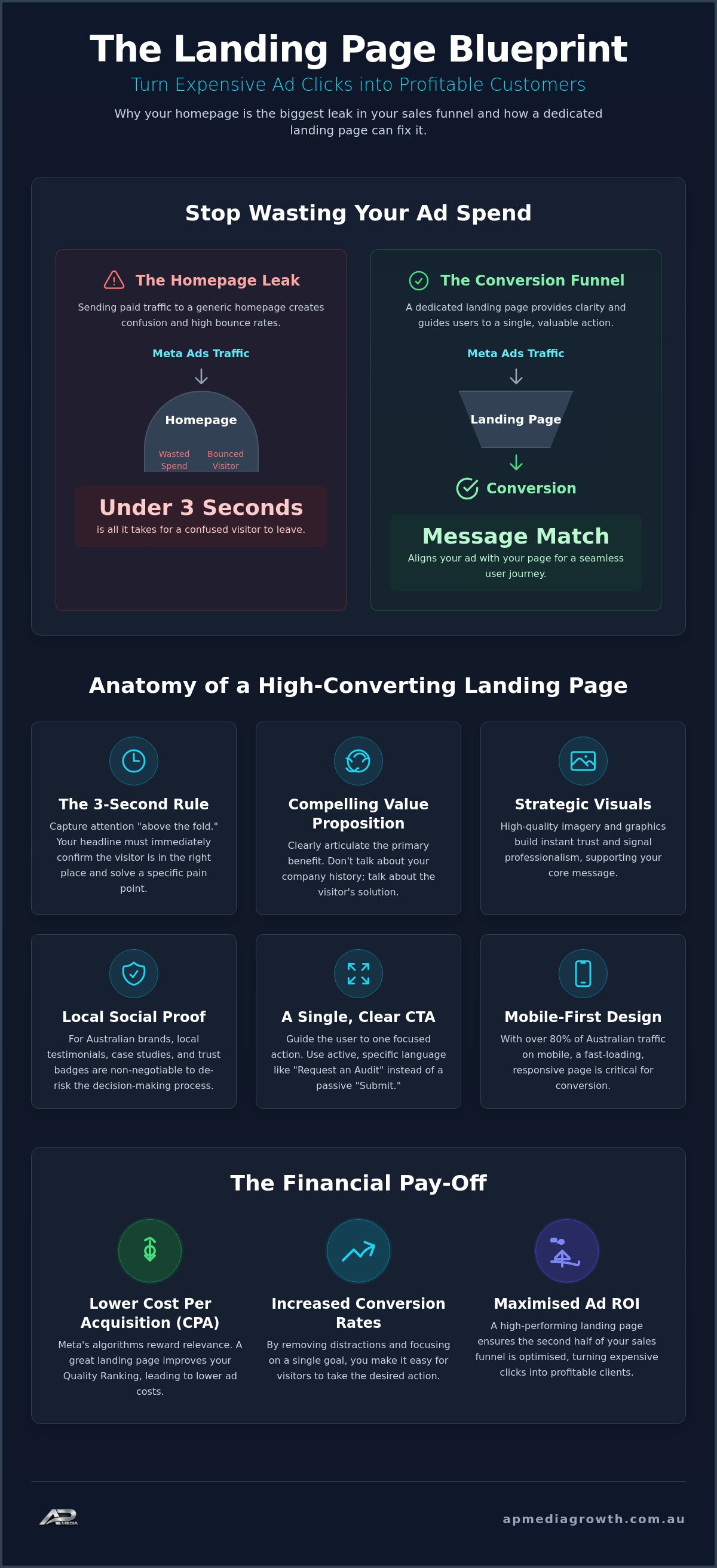
A website landing page is not just another URL on your domain; it is a precision-engineered destination designed for a singular purpose. While your homepage serves as a digital reception desk, a specialised campaign page acts as your most aggressive closer. Understanding what a landing page is in a strategic context means viewing it as the bridge between an ad click and a bank deposit. It removes the friction that usually kills digital momentum. By narrowing the focus to one specific offer, you provide the clarity that modern consumers demand before they part with their data or their dollars.
Sending paid traffic to your homepage is a rookie error that bleeds marketing budget every single day. When a user clicks your Meta Ad, they expect an immediate continuation of that specific conversation. If they land on a generic homepage, they are forced to hunt for information, leading to high bounce rates and wasted spend. We call this "Message Match." Your ad's creative and your page's headline must align perfectly to validate the user's decision to click. Without this alignment, you aren't just losing a lead; you are paying Meta to frustrate your potential customers.
Homepage vs. Landing Page: The Critical Difference
Homepages are built for exploration. They offer navigation menus, "About Us" sections, and links to various services. This is fine for organic visitors, but for paid traffic, it creates a "Leaky Bucket" syndrome. Every link that doesn't lead to your conversion goal is a potential exit point. Landing pages are built for execution. Navigation menus are the enemy of conversion on a campaign page. If you give a visitor five places to go, four of them are the wrong way. By removing these distractions, you reduce the cognitive load on the Australian consumer, guiding them toward a single, decisive action without the noise of a traditional site structure.
The Financial Impact of a Dedicated Page
The efficiency of your website landing page directly dictates your Cost Per Acquisition (CPA). Meta's algorithms reward relevance. When your landing page content mirrors your ad creative, your Quality Ranking improves, often resulting in lower costs for ad placements. This isn't just about aesthetics; it's about bottom-line performance. A high-converting page ensures that the premium you pay for Sydney or Melbourne traffic isn't squandered on a confusing user experience. Meta Ads management is only half the battle. If the second half of your funnel is broken, your growth will stall regardless of your ad creative. Ultimately, the ROI potential of landing page conversion optimisation rests on its ability to turn expensive clicks into profitable clients through sheer strategic focus.
Anatomy of a High-Converting Page: Beyond the Hero Image
A high-performing website landing page is built on a foundation of psychological triggers and logical information hierarchy. It isn't enough to have a visually appealing design; you must have a functional one. You have roughly three seconds to convince a visitor they are in the right place before they bounce. This is the "Above the Fold" rule. Within this critical window, your headline must articulate a specific value proposition that speaks directly to a known pain point. To refine your core messaging, you can discover Branding TITANS™ and their expertise in crafting mission statements that resonate. If your visitor is struggling with high lead costs, your headline shouldn't talk about your company history. It should talk about their solution.
Effective visuals serve a functional purpose beyond decoration. High-quality imagery or custom graphics build immediate professional trust, signalling that your business is established and capable of delivering results. This visual credibility supports your Call to Action (CTA), which should be prominent and strategically placed to catch the eye immediately after your value proposition has landed. It needs to be a clear, active instruction such as "Request a Growth Audit" or "Download the Strategy" rather than a passive "Submit." Understanding these elements of a successful landing page allows you to move from guessing to engineering outcomes.
The Persuasive Power of Social Proof
Trust is a currency that's hard to earn but easy to spend. For Australian brands, local social proof is non-negotiable. A Sydney-based business owner wants to see that you've helped other local enterprises succeed. Integrating testimonials, detailed case studies, and trust badges de-risks the decision-making process for the user. It moves the conversation from what you claim you can do to what you've already achieved. If you're looking to refine your own conversion strategy, our team can help you build a high-converting digital presence that prioritises these essential trust signals.
Form Optimisation: Reducing Friction
Every field in your lead generation form is a potential hurdle. While it's tempting to ask for a prospect's entire history, the "Less is More" approach usually wins. You must balance the need for lead quality with the necessity of lead quantity. If you're selling a high-ticket service, a few extra qualifying fields might filter out tyre-kickers. For broader offers, stick to the essentials. Progressive profiling is another powerful tool; it allows you to gather data over several interactions rather than overwhelming the user on their first visit. Keep the friction low to keep the conversion rate high.
Lead Gen vs. Click-Through: Choosing the Right Framework
Determining the structural framework of your website landing page is a decision that must precede the first line of code or copy. You cannot build an effective asset without first defining the specific conversion event you want to trigger. Generally, businesses operate within two primary architectures: lead generation or click-through. Choosing the wrong one is a fast way to confuse your audience and tank your return on ad spend. Your digital growth strategy depends on this alignment between user intent and page functionality. For a comprehensive overview of landing pages and their technical classifications, it is worth understanding how these archetypes differ in their psychological approach.
Lead generation pages are the workhorses for B2B firms, service providers, and high-ticket retailers. The goal here is data acquisition. You are asking for a name, email, or phone number in exchange for value. Conversely, click-through pages act as a persuasive bridge. They are common in e-commerce, designed to "warm up" a visitor before they hit the final checkout page. Instead of a form, the primary CTA is a button that leads to a transaction. Both frameworks have their place, but they require vastly different content hierarchies to succeed in the Australian market.
When to Use a Lead Generation Page
The success of a lead generation page hinges on the perceived value of your exchange. This is where the "Lead Magnet" strategy comes into play. You might offer a whitepaper, a free audit, or an exclusive webinar to incentivise the visitor. It is about nurturing the prospect and building authority before asking for a high-commitment sale. For example, effective social media advertising frequently relies on these pages to capture interest from cold audiences, turning a casual scroller into a qualified lead through a structured data-capture process.
The Role of the Click-Through Landing Page
A click-through landing page is all about momentum. Its job is to overcome objections and highlight product benefits mid-funnel so that by the time the user reaches the cart, the sale is already made. You can use elements of scarcity or urgency, like limited-time offers or stock counters, to encourage immediate action. However, these must be used ethically to maintain brand trust. For a niche e-commerce brand like personalised pet tags australia, the focus is on a transactional purchase, ensuring the transition from the website landing page to the checkout is as seamless and frictionless as possible.
Conversion Rate Optimisation (CRO) for the Australian Market
Conversion rate optimisation in the Australian market isn't a one-size-fits-all global strategy. It requires a deep understanding of local consumer behaviour and technical constraints. Australians are pragmatic, mobile-heavy, and naturally sceptical of vague marketing claims. If your website landing page doesn't load perfectly on a smartphone, you've already lost the lead. Data indicates that over 80% of Sydney-based traffic arrives via mobile devices. These users expect an immediate, frictionless experience. If your page takes longer than three seconds to load, research shows Australian mobile users are likely to leave before seeing your offer.
Trust is your primary currency. Localised trust signals like displaying your Australian Business Number (ABN) and a local AU phone number are essential for de-risking the decision-making process. Using Sydney-centric language and local references helps bridge the gap between a cold ad and a warm lead. Most users are skimmers who follow an "F-pattern" of reading, scanning headlines and the left side of the screen for key information. Layout your content to catch their eye where it naturally falls, using punchy headlines and clear bullet points to deliver value quickly.
Technical Performance and User Experience
Australia's internet speeds vary significantly across different regions. Optimising images and scripts is a non-negotiable step to prevent slow load times from killing your campaign. Core Web Vitals serve as the definitive benchmark for user retention by measuring the real-world speed, responsiveness, and visual stability of your digital experience. Additionally, adhering to WCAG 2.2 Level AA is now a standard expectation for accessibility under the Disability Discrimination Act 1992. Making your page usable for everyone isn't just a legal requirement; it's a fundamental part of a professional digital presence.
A/B Testing: The Path to Perfection
Never assume you know exactly what your audience wants. Testing headlines, button colours, and CTA copy allows for incremental gains that compound over time. In the Australian market, it's vital to reach statistical significance before making major strategic pivots. This disciplined approach ensures your growth is backed by evidence rather than guesswork. If you want to stop leaving revenue on the table, partner with our strategic growth experts to engineer a page that actually converts. Every small adjustment in your testing phase can lead to a lower cost-per-lead and a more efficient sales funnel.
Partnering for Performance: Professional Landing Page Development
Building a high-performing website landing page isn't a weekend DIY project. While drag-and-drop builders are more accessible than ever, they often lack the technical depth and psychological engineering required to win in a competitive market. A professional build ensures that every element, from server-side speed to the specific hierarchy of information, is optimised for a singular outcome. For businesses seeking a more tailored approach, you can explore custom website design with specialists like Insight Multimedia to create a unique and high-performing digital presence. DIY attempts frequently fall short because they prioritise aesthetics over performance marketing fundamentals. Without the correct integration between your ad creative and your destination page, you're essentially gambling with your marketing budget.
We treat the landing page as the critical second half of your Meta Ads campaign. If your ads are the engine, the landing page is the transmission that actually moves the vehicle forward. By partnering with a strategic consultant, you gain access to data-driven frameworks that have been tested across various industries. To see how these principles are applied to high-performance campaigns, you can discover Toptarget Online Marketing Ügynökség and their specialised focus on high-ROI advertising. This isn't just about design; it's about bottom-line accountability. A strategic growth partner understands that a "pretty" page is worthless if it doesn't lower your customer acquisition costs and drive measurable revenue. The first step toward improvement is a cold, hard audit of your current digital assets to identify where your sales funnel is leaking.
Why Sydney Businesses Choose AP Media Growth
Our approach is fundamentally results-oriented and pragmatic. We don't hide behind vanity metrics like "impressions" or "engagement" if they don't translate into leads or sales. Sydney businesses choose us because we specialise in the intersection of paid media and conversion. We position ourselves as an extension of your team, providing the strategic authority needed to scale your digital presence. If you're currently vetting partners, it's vital to know how to find a marketing agency in Sydney that prioritises your actual growth over creative awards.
Starting Your Conversion Journey
Success begins with a comprehensive discovery phase. We start by deeply understanding your business goals, your local competition, and the specific pain points of your Australian audience. From there, we develop a custom strategy that aligns every pixel with your data. We don't believe in "black box" methodologies; our process is transparent and focused on repeatable systems. This disciplined approach ensures that your website landing page remains a high-yielding asset rather than a static digital brochure. To further streamline your lead management and operations, check out Marketing System Solutions. Ready to turn your clicks into customers? Let's build a funnel that actually works for your bottom line.Scaling Your Digital Revenue Through Strategic Conversion
Mastering the science of the website landing page is the most direct path to stopping the bleed in your marketing budget. You've learned that sending paid traffic to a generic homepage is a mistake that costs Australian businesses thousands every year. By implementing a dedicated framework, whether it's lead generation or click-through, you provide the clarity your customers need to convert. Prioritising mobile-first design and local trust signals ensures your brand resonates in a competitive market while maintaining technical excellence. For entrepreneurs seeking high-impact business and financial resources to complement their growth, mgaffiliate.com offers access to proven success frameworks.
AP Media Growth functions as your strategic growth partner, not just another service provider. We are specialised Meta Ads and conversion experts who focus on tangible outcomes rather than vanity metrics. Our approach is fundamentally pragmatic. We offer no SEO fluff; we provide only data-driven performance strategies that scale. It's time to move past the guesswork and start building a digital presence that works as hard as you do.
Are you ready to transform your digital traffic into a consistent stream of customers? Book a Strategic Growth Consultation with AP Media Growth and take the first step toward a more efficient sales funnel. Your business has the potential to scale. Let's build the engine that makes it happen.
Frequently Asked Questions
What is the difference between a website and a landing page?
A website is a multi-page hub designed for broad exploration and brand education. In contrast, a website landing page is a standalone destination built for a single marketing objective. While your main site provides various paths for a visitor to take, a landing page removes all distractions, such as navigation menus and external links, to guide the user toward one specific action.
How much should I spend on a website landing page in Australia?
Investment levels for professional development depend entirely on the strategic complexity and technical requirements of your campaign. Rather than viewing this as a flat cost, it is more accurate to see it as a performance asset. A high-converting page pays for itself by significantly reducing your cost-per-lead over the long term. You should seek a quote based on your specific growth targets and the level of data integration required.
Does a landing page need to be on my main domain?
No, it doesn't have to be on your primary domain, though many businesses choose to use a subdomain for better tracking and technical flexibility. Using a structure like "go.yourbrand.com.au" allows you to host the page on a specialised platform without interfering with your main site's architecture. This approach is often faster to deploy and easier to manage for specific Meta Ads campaigns.
Can I use a landing page for SEO purposes?
While search engines can index these pages, they are fundamentally designed for paid traffic conversion rather than organic rankings. Because a high-performing website landing page prioritises a streamlined user experience with minimal text and no exit links, it rarely meets the traditional criteria for SEO optimisation. Our framework focuses on the immediate ROI of paid media rather than long-term organic search strategies.
How do I track the performance of my landing page?
Tracking is managed through the integration of the Meta Pixel and Google Analytics 4 (GA4) to monitor specific conversion events. You should look at metrics like form completion rates, button click-throughs, and time on page to gauge success. Heat-mapping tools are also useful for seeing how Australian users interact with your content, allowing you to identify and fix any friction points in the sales funnel.
What is a good conversion rate for a landing page in 2026?
A strong conversion rate is industry-specific, but most Australian service-based businesses should aim for a benchmark between 5% and 10%. High-performance funnels that are tightly aligned with specific ad creative can often achieve rates of 15% or higher. Your focus should be on incremental improvement through testing rather than comparing yourself to broad, often misleading, global averages.
Should I use video on my landing page?
Yes, video is a powerful tool for building immediate trust and explaining complex offers quickly. A short clip under 60 seconds can increase engagement, provided it doesn't compromise your page load speed. Given that Australian mobile users will leave a site that takes longer than three seconds to load, ensure your video is optimised and hosted on a fast, reliable content delivery network.
How many CTAs should a single landing page have?
You should have only one primary offer, but you can repeat the Call to Action (CTA) button multiple times as the user scrolls. This ensures that the opportunity to convert is always visible after you've delivered a new piece of value or social proof. Offering multiple different choices is a mistake; it leads to decision paralysis and almost always results in a lower overall conversion rate.